
Why the ‘Failed’ Crusades Still Inspire
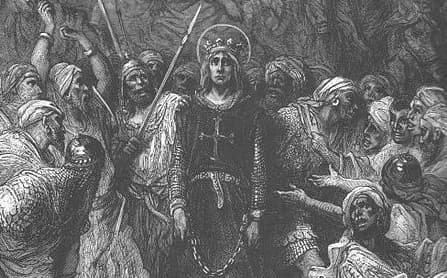
Were the Crusades a glorious and heroic venture, or were they a shameful and disastrous failure?
This is an important question with important ramifications: If, for example, the Crusades were nothing more than epic defeats, as many are fond of insisting, what on earth should anyone find inspiring about them?
To be brief, the answer comes down to numbers: the Crusaders lost, and the Muslims won, ultimately because of numbers—large Muslim numbers against small Christian numbers.
And what caused this imbalance? Simple, unlike the cold logic that fueled history’s Muslim conquests, the Christian desire to take and hold the Holy Land was motivated by purely idealistic reasons, and these ultimately proved too impractical to sustain.
Consider: history’s Muslim conquests were wholly pragmatic and followed the usual model. Muslim armies always targeted whichever “infidel” populations were closest to them. That’s because all non-Muslims were enemies, and their conquest proceeded wherever and whenever it was most convenient for Muslims.
By contrast, the Crusader effort was not aimed at conquering infidels per se, but at securing and holding a specific and highly important piece of real estate: the Holy Land—where Jesus walked, taught, died, and was resurrected.
To better understand all this, let’s take a closer look at how the Muslim conquests of history unfolded.
Beginning from their Arabian homeland, Muslim forces moved outward by subduing their most immediate neighbors. To the northwest lay Christian Syria and Egypt; to the northeast, Zoroastrian Persia. Rather than bypassing these regions in pursuit of distant objectives, Muslims first focused on conquering and fully consolidating these adjacent territories.
Only after Syria, Egypt, and Persia had been secured did Muslim armies proceed further west into North Africa, and further east into Central Asia and India. Each conquest strengthened the next. Regions were not merely occupied but brought into the “House of Islam,” the umma. This sequential, contiguous expansion ensured that Muslim forces always operated with secure lines of communication and an ever-growing base of manpower and resources immediately behind them.
In other words, Muslim armies never flung themselves deep into hostile territory, with enemies surrounding them. Instead, they advanced, step by step, always within easy reach of their own world—friendly populations, supply networks, and reinforcements, as well as defensible territory which they could retreat back to in the event of a setback.
For example, consider the Muslim conquest of Spain. Rather than try to subdue that Christian peninsula prematurely, Muslim forces first spent their energies conquering and consolidating all of North Africa, which for decades put up a stubborn defense, particularly its Berber populations. Only once that region was firmly under Muslim control, and the Berbers Islamized, did the Arabs invade Spain from their nearest African base, Morocco, in 711—some eighty years after the initial conquests of Syria and Egypt.
By then, Islam had been established all across the southern Mediterranean, from Egypt in the east to Morocco in the west: Spain was next in line.
The Crusader enterprise, by contrast, followed a radically different approach. Christian armies did not have a mandate to conquer all infidel lands between Europe and Jerusalem. Their objective was narrow, fixed, and ideological: liberating the Holy Land from Islamic tyranny. As a result, they plunged directly into the heart of enemy territory, establishing small Christian statelets surrounded on all sides by vast Muslim powers and populations. These Crusader polities were not part of a contiguous Christian realm but isolated enclaves, which received irregular and ever dwindling support from Europe.
Lacking strategic depth, secure land-based lines of communication, and a substantial local manpower base—certainly in comparison to their Muslim neighbors—the Crusader states were perpetually outnumbered. Any serious defeat was catastrophic, as there was no friendly hinterland into which they could withdraw and recover. Losses could not be easily replaced, while Muslim forces could draw upon endless resources and populations.
When, for example, Saladin was warned that King Richard the Lionheart was preparing to winter in the Holy Land in order to continue his crusade, the sultan boasted that “If it is easy for him to winter here and to be far from his family and homeland, how easy is it for me to spend a winter, a summer, then a winter and another summer in the middle of my own lands, surrounded by my sons and my family, when whatever and whoever I want can come to me.”
In short, the failure of the Crusades was not the result of insufficient courage or desire—far from it—but of a structural mismatch between idealistic objectives and material realities. History’s Muslim conquests succeeded because they were flexible, pragmatic, and geographically grounded. Their first and foremost consideration was to conquer any adjacent infidel population, once circumstances allowed.
The Crusader project, by contrast, was bound to a single sacred objective located deep within hostile territory and had nothing to do with conquering infidels but rather securing sacred territory.
From here one can begin to understand why the Crusades were indeed heroic, and inspiring. What’s noteworthy is not that they ultimately failed, but that they managed to succeed under such desperate circumstances for as long as they did—nearly 200 years.
It bears emphasizing: that a small band of men—the Crusaders—could persist for as long as they did against ever growing and insurmountable odds is, actually, pretty remarkable.
For an idea of what Muslims would have had to do to parallel the Crusaders’ achievement, imagine if Muslims, rather than conquering infidel territories in sequential piecemeal fashion, had, after conquering only Egypt, sailed directly to France, conquered several of that nation’s most important coastal cities, and then remained there, no matter what the vastly numerical forces of Europe did to eject them—for nearly two centuries.
Certainly that would be an achievement that the histories would sing of! But, because it was Christians, we’re only supposed to talk and hear about the negative—namely, that they ultimately lost—not that they did the unthinkable for nearly 200 years, and lost only due to the growing secularization of Europe, which led to even less support than before.
Before closing, I would be remiss not to mention an interesting irony, a modern day twist to this discussion, one that is currently unfolding. As it happens, Muslims today are doing precisely what the Crusaders did nearly a millennium ago: they too are forming enclaves, ribats even, right smack in the middle of the enemy’s territory—namely, Europe.
The difference, of course, is that they did not accomplish this like the Crusaders—that is, through force of arms—but because they are being welcomed in with open arms.
And perhaps that’s all you need to know about history’s Crusaders, their modern day descendants in Europe, and the Muslims. The first two—the crusaders and their descendants—are the mirror opposite of each other: the one did everything to fight for, and the other is doing everything to destroy, the faith—while the ever consistent Muslims remain the same.

Please share your thoughts on this article on X
Click here